Roles
Four roles, with checks between them.
Four roles: admin, respondent, reviewer and consultant. A consultant can compare clients side by side. An administrator cannot verify their own evidence.
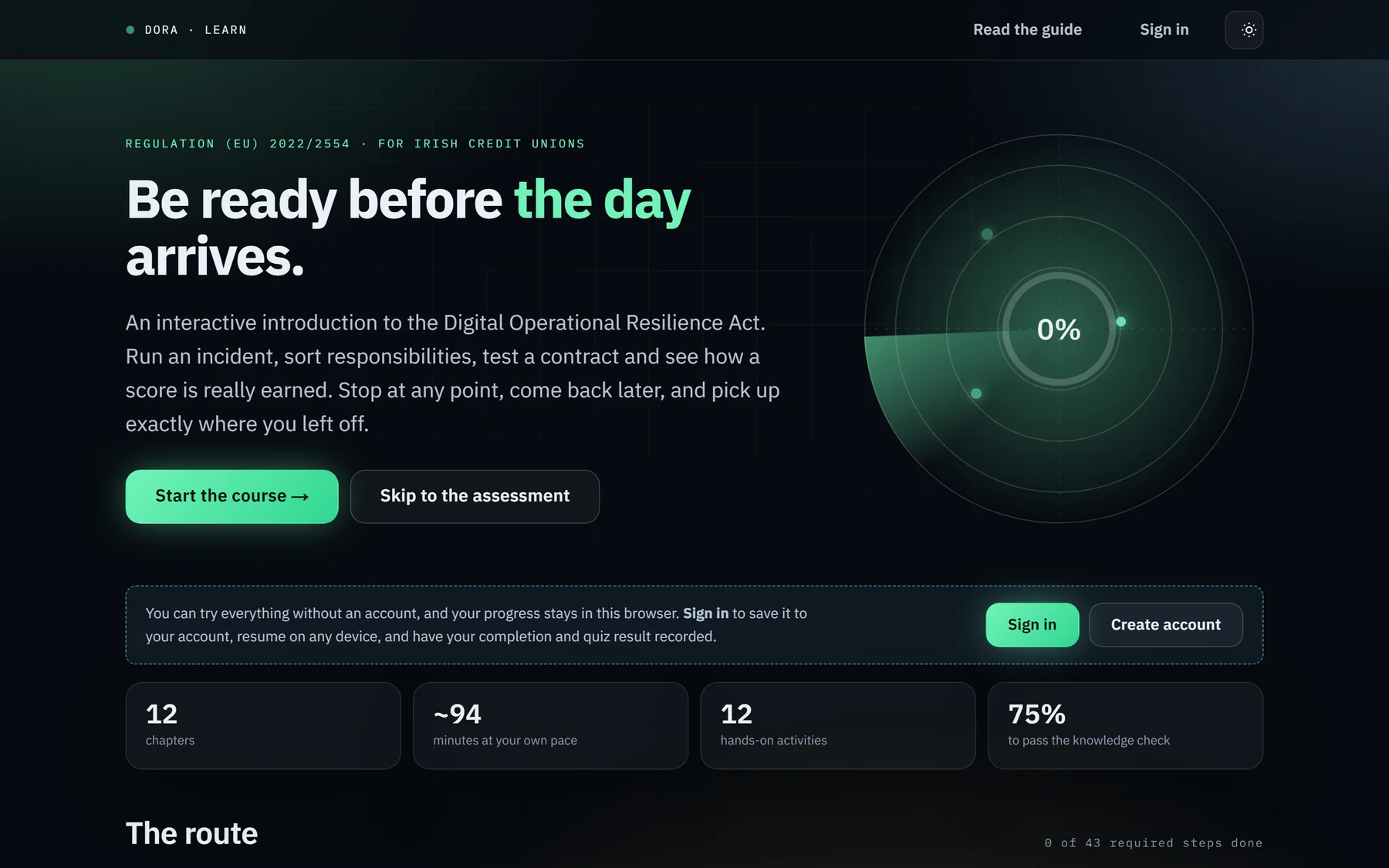
Regulation (EU) 2022/2554 sets one set of ICT resilience rules for the EU financial sector. This page explains its structure, what it expects of an organisation and how we assess readiness.
Application date across the EU for Regulation (EU) 2022/2554.
Date recorded in our assessment for Irish credit unions, under S.I. 20/2025. Confirm against the current text.
Chapters II to VI hold the duties: ICT risk, incidents, testing, third parties and information sharing.
Structure
Chapters II to VI carry the duties. The other four say who is covered, who supervises and how the rules are kept up to date. Select a chapter.
Technical standards
The Regulation sets the duty. Regulatory and implementing technical standards (RTS and ITS) set the detail. Check the current status of each before you rely on it.
Governance owned by the management body, a documented risk framework, and controls from identification through recovery. Smaller entities may use a simplified framework under Article 16.
Detect, classify and report ICT incidents. Major incidents are reported in stages to the competent authority.
A risk-based programme of tests for critical systems each year. Significant entities add threat-led penetration testing.
A strategy, a register of information, due diligence, mandatory contract terms and exit plans for every ICT provider. EU-level oversight of critical providers sits in the same chapter.
Voluntary exchange of cyber threat information inside trusted communities, with safeguards.
Our DORA assessment
Built for Irish credit unions and checked against the Regulation's articles. The demo uses a fictional credit union.
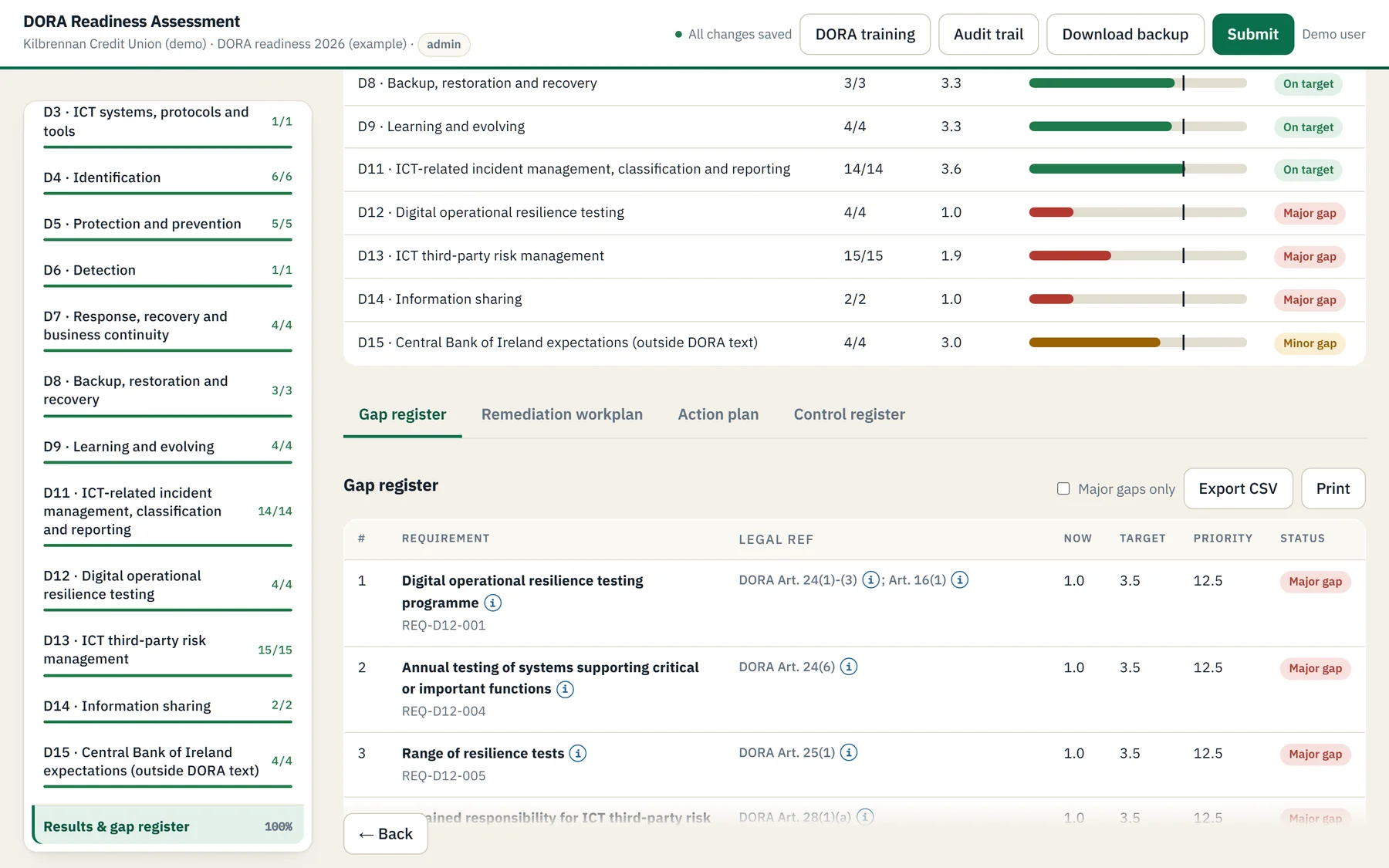
Asset size, services and ICT outsourcing set a proportionality tier and which requirements apply. In the demo, 65 of 113.
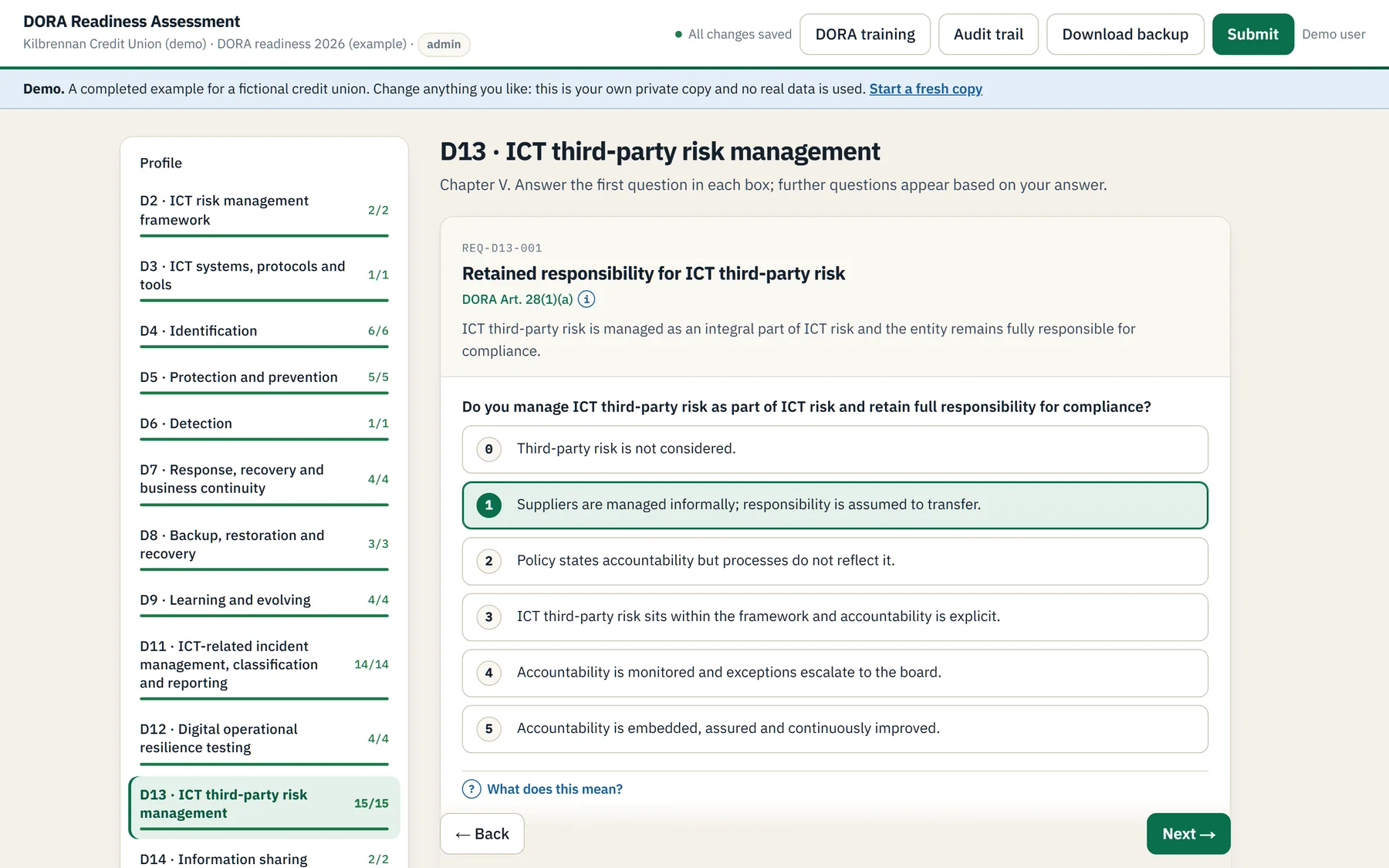
A low maturity answer asks why not and by when. A middle one asks for control detail. A high one asks for evidence.
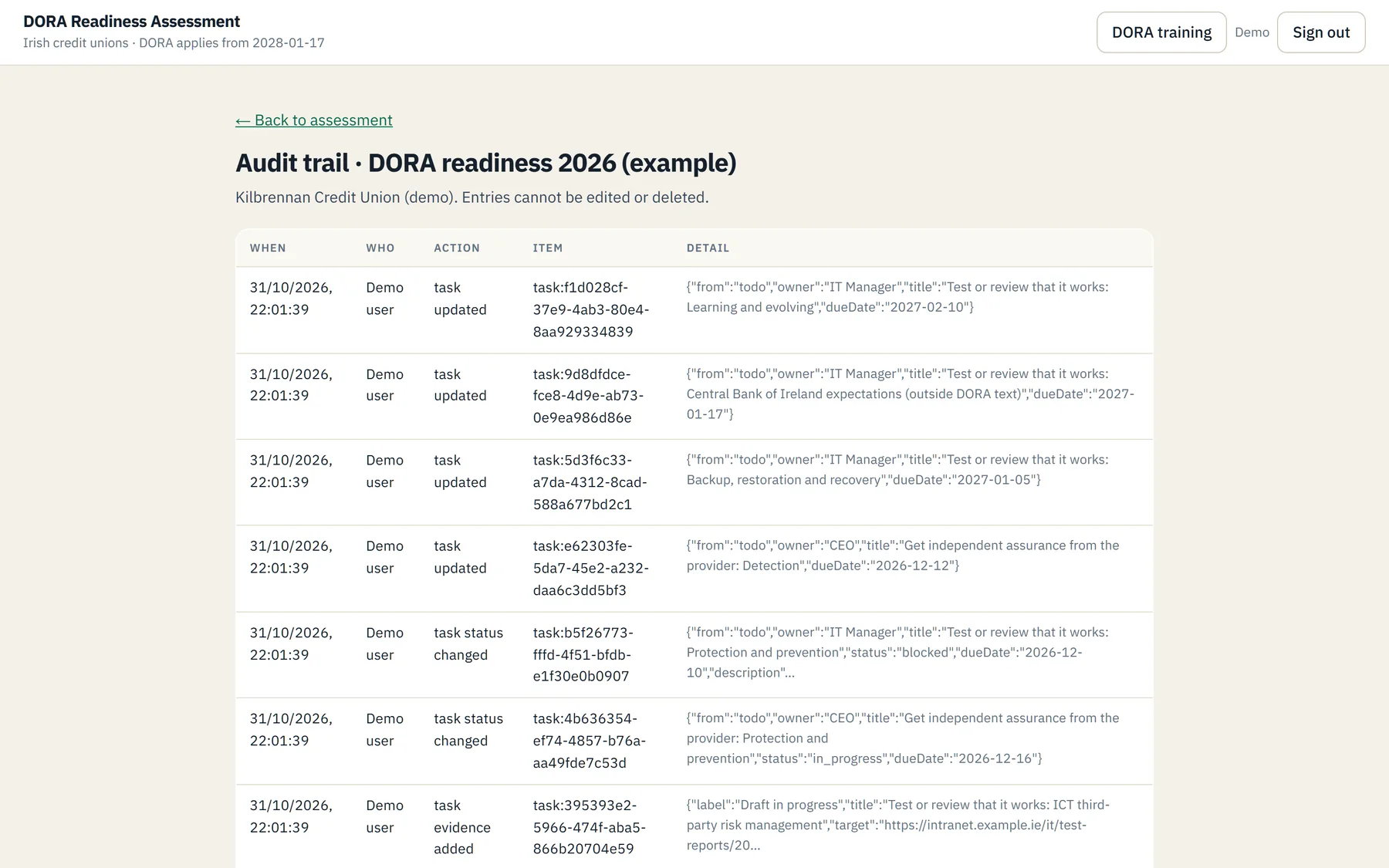
Type, reference, date, owner and upload. A reviewer rates it, and an administrator cannot verify their own.
A claim of 4 or more without evidence scores 3.0. Self-declared evidence reaches 3.5. Only verified evidence scores higher.
Maturity scale
Nothing exists.
Ad hoc and undocumented.
Written down, with an owner.
Implemented and running.
Tested, with evidence.
Continuously improved.
Outputs
Gaps are ranked by size and requirement weight, then placed into time windows.
Highest-priority gaps first.
Next tranche, within available capacity.
Structural work such as contracts and testing.
Remaining gaps and re-assessment.


Roles
Four roles: admin, respondent, reviewer and consultant. A consultant can compare clients side by side. An administrator cannot verify their own evidence.
Sets up the assessment and assigns owners. Cannot verify their own evidence.
Answers the questions and attaches the evidence behind each answer.
Rates the evidence. Only reviewer-verified evidence can lift a score above 3.5.
Reviews across clients and compares them side by side.
Contact
Tell us about the system you want built, or the regulation you need to meet. We will reply with a few questions.